
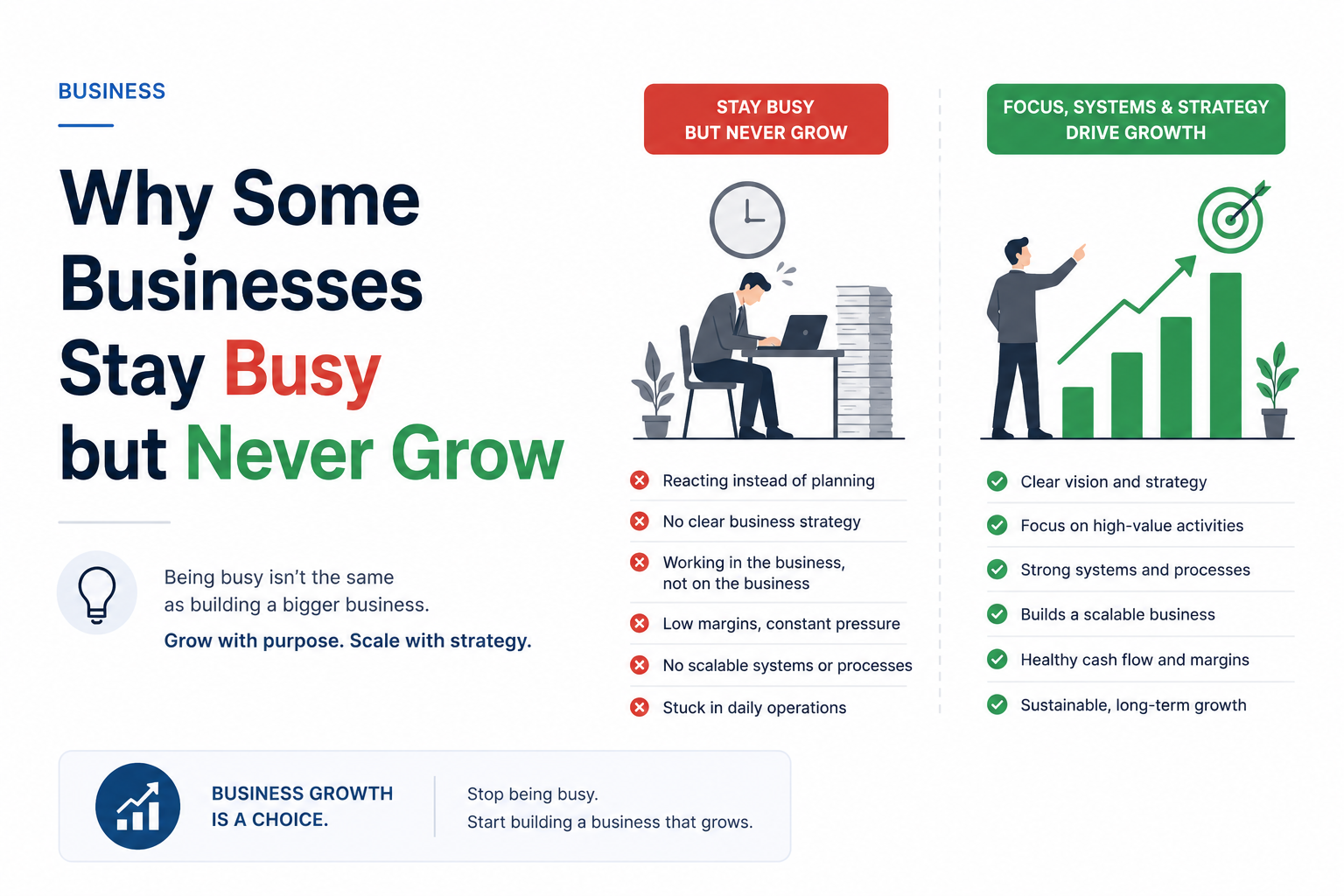
Discover why many businesses remain busy yet struggle to grow. Learn the common obstacles that prevent business growth and strategies for achieving sustainable success.
Why Some Businesses Stay Busy but Never Grow
Many business owners work long hours, manage countless tasks, and stay occupied every day, yet their businesses show little sign of meaningful growth. While being busy often feels productive, activity alone does not guarantee progress.
In fact, many companies become trapped in a cycle of constant operations without focusing on the strategic actions necessary for expansion. Understanding the difference between being busy and achieving business growth is essential for entrepreneurs who want to build scalable and sustainable organizations.
The Difference Between Being Busy and Growing
A busy business may have:
- A full schedule
- Constant customer inquiries
- Daily operational demands
- Numerous ongoing projects
However, true business growth involves:
- Increasing revenue
- Expanding market reach
- Improving profitability
- Building scalable systems
- Growing customer bases
- Strengthening brand value
Without measurable progress in these areas, a business may simply be maintaining its current position rather than advancing.
Why Some Businesses Remain Stuck
1. Focusing Only on Daily Operations
Many business owners spend most of their time handling routine tasks such as:
- Responding to emails
- Managing customer requests
- Processing orders
- Solving day-to-day issues
While these activities are necessary, they often leave little time for strategic planning and growth initiatives.
Solution
Allocate dedicated time for business development, strategic planning, and long-term goal setting.
2. Lack of Clear Growth Goals
Businesses that fail to define growth objectives often struggle to measure progress.
Without clear goals, companies may:
- Lose direction
- Miss opportunities
- Make inconsistent decisions
- Struggle to prioritize resources
Solution
Establish measurable growth targets related to revenue, customer acquisition, market expansion, and operational efficiency.
3. Failure to Delegate
Many entrepreneurs attempt to manage every aspect of their business personally.
This often results in:
- Burnout
- Reduced productivity
- Slow decision-making
- Limited scalability
Solution
Delegate responsibilities to qualified team members and focus leadership efforts on high-impact activities.
4. Inefficient Systems and Processes
As businesses grow, outdated processes can create bottlenecks that limit performance.
Common challenges include:
- Manual workflows
- Duplicate tasks
- Communication delays
- Poor resource management
Solution
Invest in systems, automation, and process improvements that increase efficiency and support growth.
5. Neglecting Marketing and Brand Development
Some businesses become so focused on serving existing customers that they stop attracting new ones.
Without consistent marketing efforts, growth opportunities may decline over time.
Solution
Maintain ongoing investments in:
- Digital marketing
- Content creation
- Search engine optimization (SEO)
- Social media engagement
- Brand awareness initiatives
A strong marketing strategy supports long-term customer acquisition and business growth.
6. Avoiding Innovation
Markets, technologies, and customer expectations continuously evolve.
Businesses that resist change often lose competitive advantages and struggle to expand.
Solution
Encourage innovation by:
- Monitoring industry trends
- Adopting new technologies
- Improving products and services
- Exploring new business opportunities
Adaptability is often a key driver of growth.
7. Poor Financial Management
Revenue alone does not guarantee growth.
Many businesses struggle because they lack visibility into:
- Cash flow
- Profit margins
- Operating expenses
- Investment opportunities
Solution
Regular financial analysis helps business owners make informed decisions and allocate resources effectively.
Signs Your Business Is Busy but Not Growing
Business owners should evaluate whether they experience any of the following:
- Revenue remains stagnant despite high activity levels
- Workloads continue increasing without improved profitability
- Expansion plans are repeatedly delayed
- Owners are involved in every decision
- Customer acquisition has slowed
- Operational issues consume most leadership attention
Recognizing these warning signs is the first step toward creating positive change.
How to Shift from Activity to Growth
Focus on Strategic Priorities
Identify activities that directly contribute to long-term business objectives.
Build Scalable Systems
Create processes that allow the business to grow without requiring proportional increases in workload.
Invest in Leadership Development
Strong leadership supports better decision-making and organizational performance.
Track Key Performance Indicators (KPIs)
Monitor metrics related to:
- Revenue growth
- Customer retention
- Profitability
- Productivity
- Marketing performance
Measurement creates accountability and supports continuous improvement.
Strengthen Customer Relationships
Satisfied customers often generate referrals, repeat business, and positive brand reputation.
Customer-focused organizations typically experience stronger long-term growth.
The Role of Technology in Business Growth
Modern technology enables businesses to operate more efficiently and scale more effectively.
Examples include:
- Customer relationship management (CRM) systems
- Business automation tools
- Data analytics platforms
- Cloud computing solutions
- Artificial intelligence applications
Technology investments can reduce operational burdens while supporting strategic growth initiatives.
Building a Growth-Oriented Mindset
Business growth requires intentional planning and consistent execution.
Growth-oriented leaders focus on:
- Long-term opportunities
- Continuous improvement
- Innovation
- Team development
- Customer value creation
Rather than simply staying busy, they prioritize activities that create measurable progress.
Conclusion
Being busy does not necessarily mean a business is growing. Many organizations become trapped in operational demands that consume time and resources without producing meaningful expansion.
Sustainable business growth requires strategic planning, effective leadership, efficient systems, innovation, and a commitment to long-term goals. By shifting focus from daily activity to growth-oriented initiatives, businesses can increase profitability, expand their market presence, and build a stronger foundation for future success.
The most successful businesses are not simply the busiest—they are the ones that consistently invest in growth, improvement, and innovation.
