
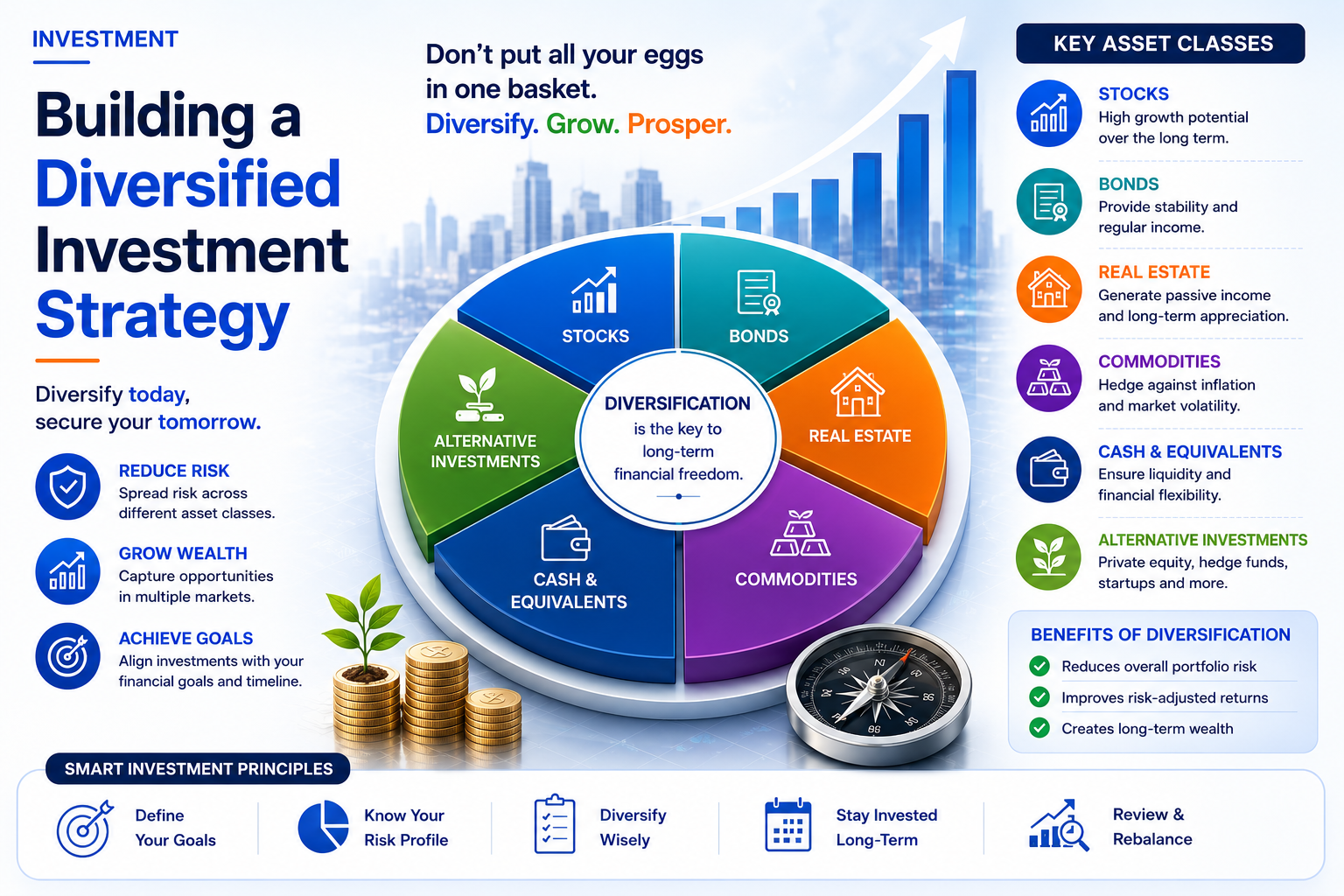
Learn how to build a diversified investment strategy that helps manage risk, protect capital, and support long-term financial growth through smart investment decisions.
Building a Diversified Investment Strategy
Successful investing is not simply about choosing the right asset at the right time. One of the most important principles of long-term financial success is diversification. A well-planned investment strategy helps investors manage risk while creating opportunities for consistent growth across changing market conditions.
Whether you are an entrepreneur, business owner, or individual investor, building a diversified investment strategy can help protect your portfolio from volatility and improve your chances of achieving financial goals.
Understanding how diversification works is a critical step toward creating a stronger and more resilient investment plan.
What Is an Investment Strategy?
An investment strategy is a structured approach to allocating financial resources across different assets to achieve specific financial objectives.
A successful investment strategy typically considers:
- Financial goals
- Risk tolerance
- Investment timeline
- Market conditions
- Income requirements
Rather than relying on a single investment, a strategy helps investors balance risk and return through thoughtful portfolio construction.
Why Diversification Matters
Diversification involves spreading investments across different asset classes, industries, and geographic regions.
The goal is to reduce the impact of poor performance in any one area while maintaining opportunities for growth.
Benefits of diversification include:
- Reduced investment risk
- More stable returns
- Better protection during market downturns
- Increased long-term growth potential
- Improved portfolio resilience
Diversification does not eliminate risk entirely, but it can help manage uncertainty more effectively.
Core Components of a Diversified Investment Strategy
1. Equities (Stocks)
Stocks represent ownership in companies and offer potential for long-term capital appreciation.
Investors often diversify stock holdings across:
- Large-cap companies
- Mid-cap companies
- Small-cap companies
- Domestic markets
- International markets
Equities can provide strong growth opportunities but may experience higher volatility.
2. Fixed-Income Investments
Fixed-income assets generally provide predictable income and lower risk compared to stocks.
Examples include:
- Government bonds
- Corporate bonds
- Treasury securities
- Fixed-income funds
These investments can help stabilize a portfolio during periods of market uncertainty.
3. Real Estate Investments
Real estate remains a popular diversification tool due to its potential for both income generation and capital appreciation.
Investment options include:
- Residential properties
- Commercial properties
- Real estate investment trusts (REITs)
- Property development projects
Real estate can provide additional portfolio diversification because its performance may differ from traditional financial markets.
4. Cash and Cash Equivalents
Maintaining a portion of assets in cash or highly liquid investments provides flexibility and financial security.
Examples include:
- Savings accounts
- Money market funds
- Short-term deposits
Liquidity allows investors to respond to opportunities and unexpected financial needs.
5. Alternative Investments
Some investors diversify further through alternative asset classes such as:
- Private equity
- Venture capital
- Commodities
- Infrastructure investments
Alternative investments may offer unique growth opportunities but often involve higher complexity and risk.
Factors to Consider When Building an Investment Strategy
Define Financial Goals
Investment decisions should align with specific objectives such as:
- Wealth accumulation
- Retirement planning
- Business expansion
- Education funding
- Income generation
Clear goals help determine appropriate investment allocations.
Understand Risk Tolerance
Every investor has a different comfort level regarding market fluctuations.
Risk tolerance depends on factors such as:
- Financial situation
- Investment experience
- Time horizon
- Personal preferences
Understanding risk tolerance helps create a portfolio that remains manageable during periods of volatility.
Consider Investment Time Horizon
Long-term investors may be able to accept greater short-term fluctuations in exchange for higher growth potential.
Shorter investment timelines often require more conservative strategies focused on capital preservation.
Review Portfolio Regularly
Markets change over time, causing portfolio allocations to shift.
Regular reviews help ensure investments remain aligned with objectives and risk tolerance.
Common Diversification Mistakes to Avoid
Overconcentration
Investing too heavily in a single asset, industry, or company can increase risk significantly.
Chasing Market Trends
Following short-term market excitement without proper analysis can lead to poor investment decisions.
Ignoring Risk Management
Diversification should balance growth opportunities with appropriate risk controls.
Lack of Long-Term Perspective
Frequent portfolio changes based on short-term market movements can undermine long-term performance.
The Role of Technology in Modern Investing
Technology has transformed how investors build and manage portfolios.
Digital tools now provide access to:
- Portfolio analytics
- Market research
- Investment platforms
- Automated investment solutions
- Risk assessment tools
These technologies help investors make more informed and efficient decisions.
Investment Strategy for Entrepreneurs
Entrepreneurs often face unique financial considerations because much of their wealth may already be tied to their businesses.
Diversification becomes especially important by helping to:
- Reduce dependence on a single income source
- Protect personal wealth
- Improve financial stability
- Create additional growth opportunities
Balancing business investments with other asset classes can strengthen overall financial resilience.
Long-Term Benefits of Diversification
A diversified investment strategy supports:
- Consistent wealth building
- Risk management
- Financial flexibility
- Improved portfolio stability
- Greater confidence during market fluctuations
Investors who maintain disciplined and diversified approaches are often better positioned to achieve their financial objectives.
Conclusion
Building a diversified investment strategy is one of the most effective ways to manage risk while pursuing long-term financial growth. By allocating investments across multiple asset classes, industries, and markets, investors can create more resilient portfolios capable of navigating changing economic conditions.
Successful investing requires clear goals, thoughtful planning, ongoing evaluation, and a commitment to long-term decision-making. While no strategy can eliminate risk entirely, diversification remains a proven approach for protecting capital and supporting sustainable financial success.
For entrepreneurs and investors alike, a well-diversified investment strategy provides a strong foundation for future growth and financial security.
