
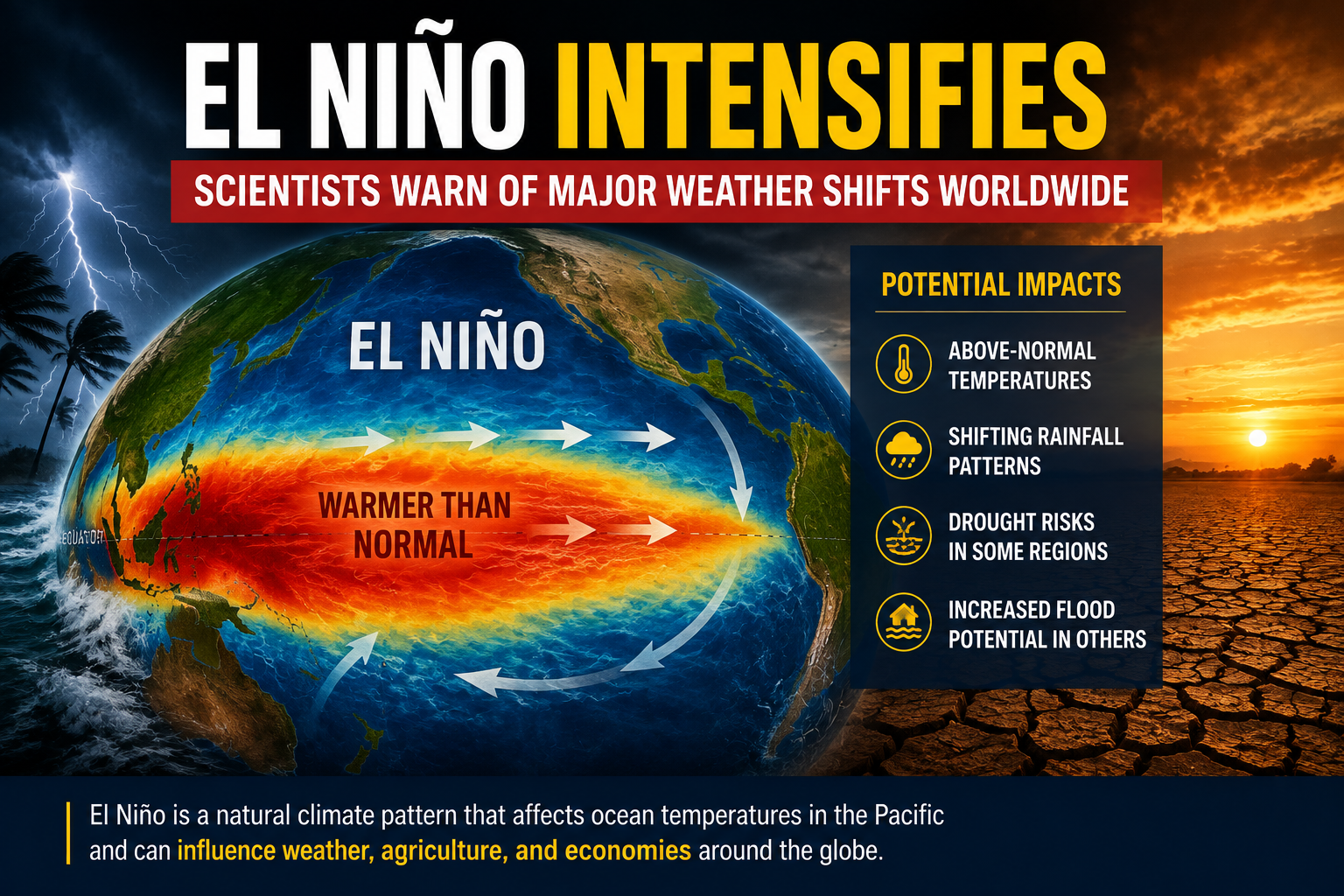
A strengthening El Niño is drawing growing international attention as climate experts warn that the natural weather phenomenon could influence temperatures, rainfall and extreme weather patterns across large parts of the world in the months ahead.
The World Meteorological Organization has reported that El Niño continues to intensify and is expected to play a significant role in global climate conditions during the August-to-October 2026 period.
While El Niño does not produce identical conditions everywhere, its influence can alter atmospheric circulation across enormous distances. For some countries, that can mean unusually dry weather. For others, it can contribute to heavier rainfall, warmer temperatures or changes in storm activity.
The latest development is therefore being watched closely by governments, farmers, energy companies, disaster-management agencies and climate scientists.
What Is El Niño?
El Niño is a naturally occurring climate phenomenon associated with unusually warm surface waters in the central and eastern tropical Pacific Ocean.
Those warmer ocean conditions can affect the atmosphere above the Pacific and eventually influence weather patterns thousands of kilometres away.
This is what makes El Niño particularly important.
An event beginning in the Pacific Ocean can have consequences for agriculture in one continent, rainfall in another and temperatures across large parts of the globe.
El Niño is part of a larger climate cycle known as the El Niño-Southern Oscillation, commonly called ENSO.
The cycle generally moves between three conditions: El Niño, La Niña and a neutral phase.
During El Niño, warmer Pacific waters can reshape atmospheric circulation. During La Niña, cooler-than-normal conditions can produce a different set of global effects.
Above-Normal Temperatures Become a Key Concern
One of the biggest concerns surrounding the strengthening 2026 El Niño is temperature.
The World Meteorological Organization says the phenomenon is expected to increase the likelihood of above-normal temperatures across much of the world during the coming months.
That does not mean every country will experience record heat.
Weather conditions are influenced by many factors, including geography, seasonal patterns, ocean temperatures and regional atmospheric systems.
However, when El Niño combines with the broader warming of the global climate, scientists pay particularly close attention to the possibility of unusually high temperatures.
Extreme heat can affect far more than daily comfort.
Long periods of high temperatures can place pressure on electricity systems, increase demand for cooling, affect agricultural production and create health risks for vulnerable populations.
Cities can face additional challenges because concrete, roads and buildings absorb and retain heat.
Rainfall Patterns Could Shift
Temperature is only part of the story.
El Niño can also change where and when rain falls.
Some regions may experience reduced rainfall and an increased risk of drought, while other areas could see unusually heavy precipitation.
These changes can have major economic consequences.
Agriculture remains particularly vulnerable because farmers depend heavily on predictable seasonal conditions.
Too little rain can damage crops, reduce water supplies and affect livestock.
Too much rain can create different problems, including flooding, soil erosion and crop destruction.
The exact impact will vary significantly between regions, meaning national weather agencies will remain essential for providing local forecasts.
Agriculture Could Feel the Impact
Farmers around the world are likely to be among those watching El Niño most carefully.
Agricultural markets are deeply connected to weather.
Rice, wheat, corn, coffee, cocoa, sugar and other major commodities can all be affected when rainfall or temperature conditions move significantly outside normal seasonal ranges.
A poor harvest in a major producing country can influence prices far beyond its borders.
This is because modern food supply chains are global.
Countries frequently import agricultural products from regions thousands of kilometres away. When weather disrupts production, the effects can move through international markets.
Food companies may face higher costs, governments may reconsider import strategies and consumers can eventually see changes in retail prices.
El Niño therefore has the potential to become an economic story as well as a climate story.
Energy Markets Are Watching Too
Energy systems can also be affected by changing weather.
Periods of extreme heat typically increase electricity demand as households and businesses use air-conditioning and cooling systems more frequently.
Meanwhile, changes in rainfall can affect hydroelectric power generation in countries that depend heavily on reservoirs and rivers.
Drought can reduce water levels, potentially limiting electricity generation.
Heavy rainfall can create a different set of infrastructure challenges.
Energy companies and governments may therefore need to prepare for unusual patterns of electricity demand and supply.
Flood and Drought Risks Differ by Region
One of the most important things to understand about El Niño is that there is no single global outcome.
It would be inaccurate to say that El Niño simply causes drought or simply causes flooding.
Its effects depend heavily on location.
A weather pattern associated with reduced rainfall in one region may simultaneously contribute to wetter-than-normal conditions somewhere else.
That is why international forecasts should be combined with information from national and regional meteorological agencies.
Communities with histories of flooding, drought, wildfires or extreme heat may need to pay particularly close attention to changing forecasts.
El Niño and Climate Change Are Different
El Niño is sometimes confused with climate change, but they are not the same phenomenon.
El Niño is a natural climate cycle that has occurred for centuries.
Human-driven climate change, by contrast, refers to the long-term warming of the planet caused primarily by increasing concentrations of greenhouse gases in the atmosphere.
However, the two can interact.
When a naturally occurring El Niño raises temperatures temporarily, it happens against a global climate that has already become warmer over the long term.
This combination can contribute to particularly warm periods.
Scientists therefore examine both short-term natural climate variability and long-term climate trends when analysing unusual global temperatures.
Governments May Need to Prepare Early
The strengthening El Niño provides governments with an opportunity to prepare before the most serious effects appear.
Weather forecasting has improved significantly, allowing scientists to identify large-scale climate patterns months in advance.
That information can help authorities make preparations.
Agricultural agencies can provide guidance to farmers.
Water authorities can review reservoir levels and drought plans.
Emergency-management agencies can prepare for flooding or extreme heat.
Energy providers can assess potential changes in electricity demand.
Hospitals and health authorities can also prepare for heat-related illnesses where unusually high temperatures are expected.
Early preparation cannot eliminate weather risks, but it can reduce their impact.
Businesses Are Also Paying Attention
El Niño is increasingly important for companies with international supply chains.
Businesses involved in agriculture, shipping, insurance, food production, energy and commodities may be particularly exposed to weather disruptions.
A company does not necessarily need to operate in an affected region to feel the consequences.
If an important supplier experiences flooding or drought, production delays can move through the supply chain.
Insurance companies also monitor major climate patterns because severe weather can increase claims associated with floods, storms, fires and agricultural losses.
The Coming Months Will Be Closely Watched
Scientists will continue monitoring Pacific Ocean temperatures, atmospheric conditions and regional weather patterns as the 2026 El Niño develops.
Forecasts will also evolve as new observations become available.
For ordinary people, the most important information will ultimately come from local weather authorities because the global El Niño pattern affects individual regions differently.
What is already clear is that the phenomenon has strengthened enough to attract serious international attention.
From farms and food markets to electricity networks and disaster planning, the potential consequences extend far beyond the Pacific Ocean.
As the world moves through the remaining months of 2026, El Niño could become one of the year’s most closely watched climate stories.
Its full impact remains uncertain, but the strengthening climate pattern is another reminder of how closely connected the world’s oceans, atmosphere, economies and communities have become.
