
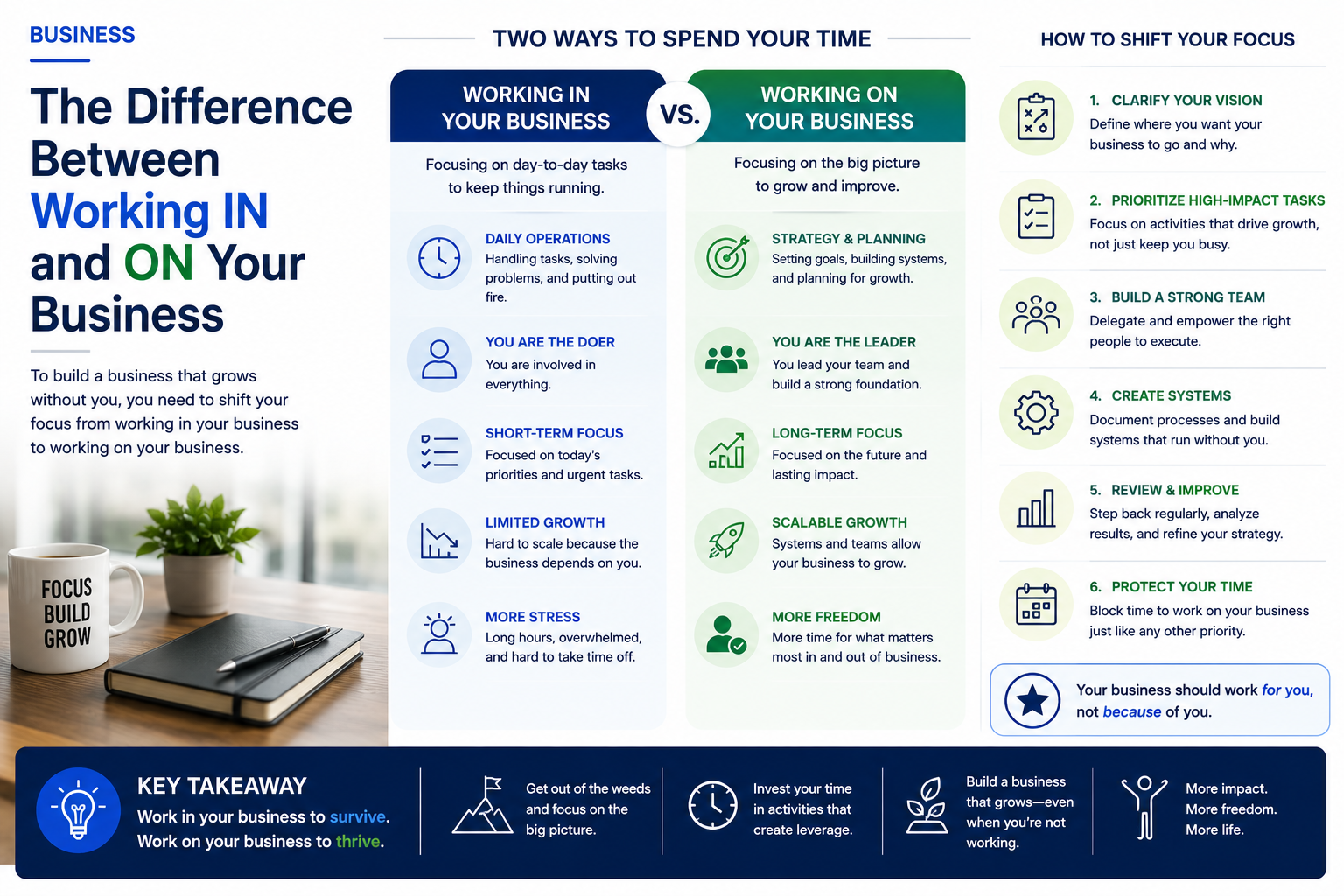
Learn the difference between working in and on your business. Discover how effective business management strategies can help business owners achieve sustainable growth and long-term success.
The Difference Between Working In and On Your Business
Many entrepreneurs start their businesses with a vision of freedom, growth, and long-term success. However, as the business grows, many owners find themselves overwhelmed by daily operations, customer requests, administrative tasks, and problem-solving. They spend so much time working in the business that they rarely have the opportunity to work on it.
Understanding the difference between these two approaches is one of the most important principles of effective business management. Businesses that achieve sustainable growth often have leaders who dedicate time not only to running daily operations but also to planning, improving, and scaling the business for the future.
What Does Working In Your Business Mean?
Working in your business refers to handling the day-to-day activities required to keep operations running smoothly.
Examples include:
- Responding to customer inquiries
- Processing orders and invoices
- Managing staff schedules
- Handling administrative tasks
- Solving operational issues
- Delivering products or services
- Managing daily workflows
These activities are necessary for business continuity, but they are primarily focused on maintaining current operations rather than driving future growth.
Benefits of Working In the Business
Working directly within operations can help business owners:
- Understand customer needs
- Maintain quality control
- Address immediate challenges
- Build strong relationships with employees and clients
However, spending all your time on operational tasks can limit growth opportunities.
What Does Working On Your Business Mean?
Working on your business involves focusing on strategic activities that improve performance, create efficiencies, and support long-term growth.
Examples include:
- Business planning
- Market analysis
- Strategic decision-making
- Leadership development
- Process improvement
- Business development initiatives
- Technology adoption
- Expansion planning
These activities help shape the future direction of the organization and create opportunities for growth.
Benefits of Working On the Business
Business owners who focus on strategic management often experience:
- Increased scalability
- Better operational efficiency
- Stronger financial performance
- Improved decision-making
- Greater competitive advantage
- Sustainable long-term growth
Working on the business allows leaders to move from simply managing operations to actively building a stronger organization.
Why Many Business Owners Stay Stuck Working In the Business
Many entrepreneurs struggle to shift from operational tasks to strategic leadership.
Common reasons include:
Fear of Delegation
Some business owners believe that no one can perform tasks as effectively as they can.
Lack of Systems
Without documented processes, delegation becomes difficult and inconsistent.
Constant Firefighting
Operational challenges consume time and attention, leaving little room for strategic planning.
Small Team Structures
In growing businesses, owners often wear multiple hats and handle responsibilities across various functions.
While these challenges are understandable, remaining trapped in daily operations can prevent businesses from reaching their full potential.
Signs You Are Working Too Much In Your Business
Business owners may be spending too much time in operations if:
- Every decision requires their approval
- They struggle to take time off
- Growth has stalled despite high activity levels
- Daily tasks consume most of their schedule
- Strategic planning is consistently postponed
- Employees rely heavily on them for routine decisions
These signs often indicate a need for stronger systems, delegation, and leadership development.
How to Start Working More On Your Business
1. Create Clear Processes
Documenting workflows and procedures allows tasks to be delegated more effectively.
Standardized processes improve consistency and reduce dependence on business owners.
2. Delegate Responsibilities
Empowering employees to handle operational tasks creates more time for strategic initiatives.
Delegation also supports employee development and accountability.
3. Schedule Strategic Planning Time
Business owners should dedicate regular time to:
- Reviewing goals
- Evaluating performance
- Analyzing market trends
- Identifying growth opportunities
Strategic planning should be treated as a business priority rather than an optional activity.
4. Invest in Technology
Technology can automate repetitive tasks and improve efficiency.
Examples include:
- Customer relationship management (CRM) systems
- Accounting software
- Business automation tools
- Project management platforms
These solutions free up valuable time for higher-level business management activities.
5. Focus on Leadership
As businesses grow, owners must transition from operators to leaders.
Effective leadership involves:
- Setting direction
- Building teams
- Developing talent
- Driving innovation
Strong leadership supports long-term organizational success.
The Role of Business Management in Sustainable Growth
Successful business management requires balancing operational excellence with strategic vision.
Leaders must ensure that:
- Daily operations remain efficient
- Resources are allocated effectively
- Teams remain aligned with company goals
- Growth opportunities are continuously explored
Organizations that achieve this balance are often better positioned to scale successfully.
How Citrix Project Development Consultant LLC Helps Businesses Grow
Many businesses struggle to move beyond daily operational challenges because they lack the systems, strategies, and expertise needed to support growth.
Citrix Project Development Consultant LLC provides professional business consulting services in Dubai and the UAE, helping organizations improve business management practices, strengthen operational efficiency, and develop sustainable growth strategies.
Through expert guidance in:
- Strategic business planning
- Business development consulting
- Process optimization
- Organizational growth strategies
- Corporate advisory services
Citrix helps businesses transition from working solely in their operations to building scalable, growth-focused organizations.
Common Mistakes Business Owners Make
To improve business management effectiveness, avoid these common mistakes:
- Micromanaging employees
- Failing to delegate responsibilities
- Ignoring long-term planning
- Neglecting process improvements
- Resisting technology adoption
- Focusing only on short-term issues
Addressing these challenges creates opportunities for sustainable growth and improved performance.
The Long-Term Impact of Working On Your Business
When business owners dedicate time to strategic management, they often achieve:
- Stronger financial results
- Increased operational efficiency
- Better team performance
- Greater scalability
- Enhanced customer experiences
- Long-term business sustainability
The goal is not to eliminate involvement in daily operations entirely but to create a balance that allows the business to grow beyond the owner’s direct involvement.
Conclusion
Understanding the difference between working in and on your business is essential for effective business management. While daily operational tasks are important, sustainable growth requires business owners to focus on strategic planning, leadership, innovation, and process improvement.
Organizations that prioritize working on the business are better positioned to scale, improve profitability, and remain competitive in evolving markets. By implementing strong systems, empowering teams, and seeking expert guidance from trusted advisors such as Citrix Project Development Consultant LLC, business owners can build resilient businesses designed for long-term success.
