
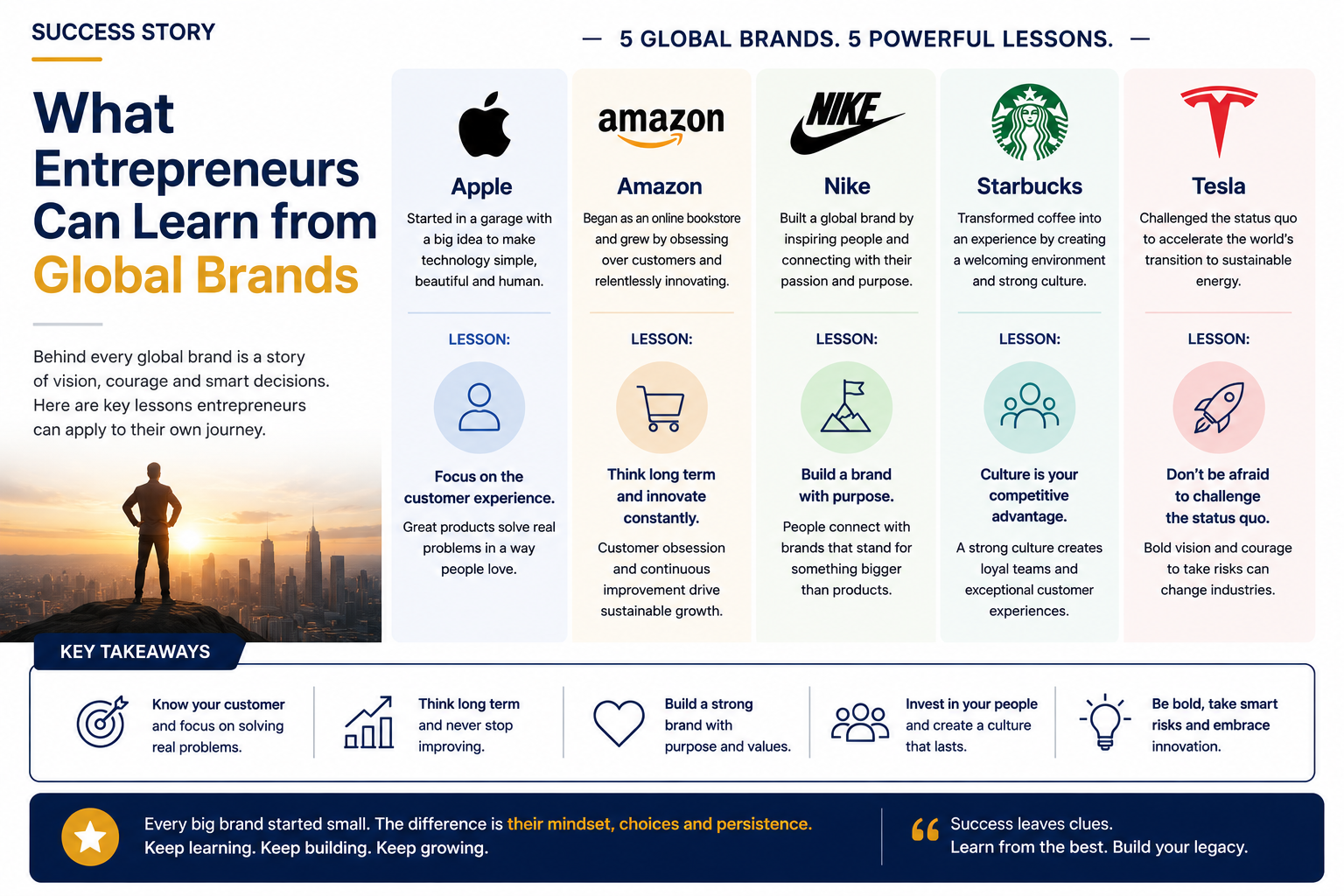
Discover valuable entrepreneur lessons from successful global brands. Learn how innovation, leadership, customer focus, and adaptability drive long-term business success.
What Entrepreneurs Can Learn from Global Brands
Some of the world’s most recognized brands started as small businesses with ambitious visions and limited resources. Through innovation, perseverance, strategic planning, and a deep understanding of customer needs, these companies transformed into global success stories.
For entrepreneurs, studying successful brands offers valuable insights into what drives sustainable business growth. While every business operates in a unique market, many of the principles behind global success can be applied by startups, small businesses, and growing enterprises alike.
Understanding these entrepreneur lessons can help business owners make better decisions, avoid common mistakes, and build stronger organizations.
Why Global Brands Offer Valuable Business Lessons
Global brands have achieved success by navigating challenges, adapting to changing markets, and continuously improving their products and services.
Entrepreneurs can learn from their experiences by observing how successful companies:
- Build strong customer relationships
- Create recognizable brands
- Innovate consistently
- Scale operations effectively
- Adapt to industry changes
These lessons remain relevant regardless of business size or industry.
Lesson 1: Put Customers First
One of the most common characteristics of successful global brands is an unwavering focus on customers.
Leading companies invest heavily in understanding:
- Customer needs
- Consumer behavior
- Purchasing preferences
- Market expectations
Businesses that prioritize customer satisfaction often benefit from stronger loyalty, positive referrals, and long-term growth.
Entrepreneur Takeaway
Focus on delivering exceptional value and consistently improving customer experiences.
Lesson 2: Build a Strong Brand Identity
Global brands understand the importance of creating a clear and consistent identity.
A strong brand includes:
- Clear messaging
- Consistent visual elements
- Defined values
- Memorable customer experiences
Brand recognition helps businesses stand out in competitive markets and build trust with customers.
Entrepreneur Takeaway
Invest in developing a brand that reflects your mission, values, and customer promise.
Lesson 3: Embrace Innovation
Innovation plays a critical role in long-term business success.
Successful brands continuously explore ways to:
- Improve products
- Enhance services
- Optimize operations
- Leverage technology
Innovation does not always require groundbreaking inventions. Small, consistent improvements can create significant competitive advantages.
Entrepreneur Takeaway
Encourage creativity and remain open to new ideas that improve business performance.
Lesson 4: Adapt to Change
Markets, technologies, and consumer preferences evolve rapidly.
Global brands often maintain their success because they adapt quickly to changing circumstances.
Adaptability may involve:
- Introducing new products
- Entering new markets
- Updating business models
- Adopting emerging technologies
Businesses that resist change risk losing relevance.
Entrepreneur Takeaway
Remain flexible and responsive to market developments.
Lesson 5: Focus on Long-Term Vision
Many successful companies prioritize long-term growth over short-term gains.
They make decisions based on:
- Sustainability
- Customer relationships
- Brand reputation
- Future opportunities
Long-term thinking supports strategic growth and resilience.
Entrepreneur Takeaway
Develop a clear vision and make decisions that align with long-term objectives.
Lesson 6: Invest in Leadership
Strong leadership is a defining characteristic of successful organizations.
Effective leaders:
- Communicate clearly
- Inspire teams
- Solve problems
- Drive innovation
- Support organizational culture
Leadership quality often influences business performance more than any other factor.
Entrepreneur Takeaway
Continuously develop leadership skills and invest in team development.
Lesson 7: Build Strong Teams
Behind every successful brand is a capable and motivated workforce.
Leading companies focus on:
- Employee engagement
- Professional development
- Collaboration
- Workplace culture
Strong teams contribute to productivity, innovation, and customer satisfaction.
Entrepreneur Takeaway
Create an environment where employees feel valued, empowered, and motivated to succeed.
Lesson 8: Use Data to Guide Decisions
Successful global brands increasingly rely on data-driven strategies.
Data helps organizations:
- Understand customers
- Measure performance
- Identify opportunities
- Reduce uncertainty
Businesses that leverage analytics can make more informed decisions and improve outcomes.
Entrepreneur Takeaway
Track key metrics and use insights to guide business strategies.
Lesson 9: Prioritize Operational Excellence
As businesses grow, operational efficiency becomes increasingly important.
Successful companies invest in:
- Process improvement
- Technology solutions
- Automation
- Resource management
Efficient operations support scalability and profitability.
Entrepreneur Takeaway
Regularly evaluate processes and seek opportunities to improve efficiency.
Lesson 10: Stay Committed During Challenges
Every successful brand has faced setbacks, economic downturns, and competitive pressures.
Resilience often separates successful businesses from those that struggle.
Strong organizations respond to challenges by:
- Adjusting strategies
- Learning from mistakes
- Maintaining focus
- Continuing to innovate
Entrepreneur Takeaway
View challenges as opportunities to learn and improve.
Common Traits Shared by Successful Global Brands
While industries differ, many successful brands share similar characteristics:
- Customer-centric mindset
- Strong leadership
- Continuous innovation
- Adaptability
- Strategic planning
- Operational efficiency
- Commitment to quality
These principles create a foundation for sustainable growth.
How Entrepreneurs Can Apply These Lessons
Business owners can implement these insights by:
Understanding Their Market
Regularly analyze customer needs and industry trends.
Investing in Technology
Use digital tools to improve operations and customer experiences.
Building a Strong Brand
Develop consistent messaging and maintain a clear value proposition.
Supporting Employees
Invest in training, engagement, and workplace culture.
Maintaining Strategic Focus
Align daily activities with long-term business goals.
Small improvements in these areas can significantly impact business performance over time.
The Future of Entrepreneurship
As technology and consumer expectations continue evolving, entrepreneurs will face both new challenges and opportunities.
Future success will increasingly depend on:
- Digital transformation
- Artificial intelligence adoption
- Customer experience innovation
- Sustainable business practices
- Agile leadership
Entrepreneurs who embrace these trends will be better positioned to compete and grow.
Conclusion
Global brands offer valuable entrepreneur lessons that can be applied to businesses of all sizes. Their success is often built on strong leadership, customer focus, innovation, adaptability, and strategic planning.
By studying how successful companies operate and applying these principles thoughtfully, entrepreneurs can strengthen their organizations, improve decision-making, and create sustainable growth opportunities.
The journey of entrepreneurship may be challenging, but learning from proven success stories can provide the guidance needed to build a thriving and resilient business.
