
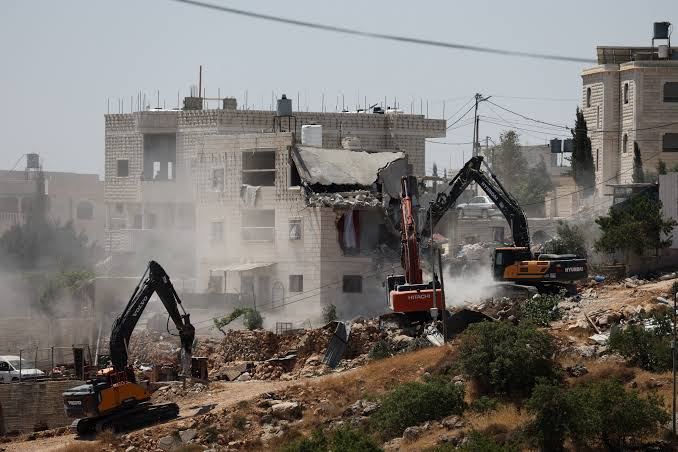
Israel is moving ahead with another major settlement expansion in the occupied West Bank, adding a tender for 2,167 housing units to the controversial E1 development plan. According to Reuters, citing Israeli rights group Ir Amim, the latest tender brings the number of housing units connected to the plan to 3,401. The move has renewed criticism from Palestinian officials, rights organisations and governments that argue continued construction in the area could make a future Palestinian state increasingly difficult to establish.
The controversy surrounding E1 is not based simply on the number of homes proposed. The project's location east of Jerusalem, near the Israeli settlement of Maale Adumim, gives it particular political and geographical importance. Palestinians seek the West Bank and East Jerusalem as central parts of a future state, while critics of E1 argue that extensive Israeli development in the area could further disrupt territorial connections between Palestinian population centres.
Why the E1 Area Is So Important
E1 has remained one of the most closely watched settlement projects for years because of its position between East Jerusalem and other parts of the occupied West Bank. Opponents argue that large-scale Israeli construction there could make Palestinian territorial continuity more difficult and further complicate efforts to negotiate a two-state settlement. Israel disputes international legal characterisations of its settlements and cites historical, security and legal claims concerning the territory.
The disagreement therefore goes far beyond housing policy. Palestinians want East Jerusalem to serve as the capital of a future independent state, while Israel considers Jerusalem its capital. The city's status, the future of Israeli settlements, borders, security arrangements and Palestinian refugees remain among the major unresolved issues of the Israeli-Palestinian conflict.
Israeli Government Support for Settlement Expansion
Israeli Finance Minister Bezalel Smotrich has strongly supported settlement expansion and has explicitly connected the E1 project with opposition to Palestinian statehood. Reuters reported that Smotrich has presented the development as a way to prevent the establishment of a Palestinian state.
That position contrasts directly with governments that continue to support a negotiated two-state solution. For those governments, preserving enough territorial continuity for a viable Palestinian state remains an important diplomatic objective. The E1 project has therefore become a particularly visible example of the widening disagreement over what the future political map of the territory should look like.
Palestinians and Foreign Governments Oppose the Move
Palestinian officials condemned the latest development and argued that settlement construction violates international law. Most countries and the United Nations regard Israeli settlements in territory occupied since the 1967 war as illegal under international law, while Israel disputes that position.
The dispute is increasingly producing economic as well as diplomatic consequences. Britain, France and Canada have taken measures targeting goods originating from Israeli settlements in the West Bank, according to Reuters. Such policies generally distinguish between Israel itself and Israeli settlements in occupied territory.
Why Settlement Expansion Has Economic Consequences
Although settlement announcements are primarily discussed as political developments, they also carry economic implications. New residential areas require roads, utilities, public services and other infrastructure. Changes to land use and transportation can affect Palestinian communities and commercial activity, while international restrictions on settlement-linked goods can create additional compliance considerations for companies operating in or sourcing products from disputed territories.
For international businesses, geopolitical exposure has therefore become increasingly relevant. Companies may need to consider trade restrictions, supply-chain disclosure requirements, sanctions risk and differing legal treatment of products depending on their place of origin. The West Bank illustrates how a territorial dispute can create complicated commercial questions far beyond the construction sector.
Timing Adds Another Political Dimension
Reuters reported that bidding connected with the latest tender is scheduled for October 25, shortly before Israel's parliamentary election scheduled for October 27. The timing places settlement policy within an already significant domestic political period in Israel, where voters and political parties hold sharply different positions on security, the West Bank and relations with the Palestinians.
Settlement policy has consequently become both an international diplomatic issue and an important part of Israeli domestic politics. Decisions made by the government can affect relations with foreign allies while also appealing to constituencies that support continued Israeli settlement in the West Bank.
The Two-State Debate Returns to the Centre
For decades, international diplomacy has largely focused on a framework in which Israel would exist alongside an independent Palestinian state. Repeated rounds of negotiations have failed to produce a permanent agreement, and developments on the ground have continued during the absence of a comprehensive peace settlement.
The renewed E1 expansion has brought the viability of that framework back into focus. Critics argue that continued settlement growth makes the geography required for two functioning states increasingly difficult to achieve. Supporters of settlement expansion reject the premise that such construction should be constrained by Palestinian territorial claims and emphasise Israeli historical and security interests.
What Happens Next
The announcement does not mean that all 2,167 newly tendered housing units will appear immediately. Large developments move through tendering, contracting, planning and construction stages, meaning implementation occurs over time. That process also leaves opportunities for legal proceedings, political changes and diplomatic pressure to affect what ultimately happens.
Nevertheless, moving the tender forward represents another concrete step in the E1 project. With 3,401 housing units now associated with the broader plan, the development is likely to remain a source of disagreement between Israel, Palestinian representatives and governments supporting a negotiated two-state settlement.
The significance of E1 ultimately comes down to geography and competing political objectives. Israeli supporters of the project see settlement expansion as reinforcing Israel's presence in territory they consider strategically and historically important. Palestinians and opponents of the project see the same development as reducing the possibility of establishing a contiguous future Palestinian state.
That fundamental disagreement is why a housing development east of Jerusalem continues to carry consequences far beyond the construction site.